Spring 2026
Even the most challenging lab work or demanding internship doesn’t usually expose students to the feeling of having someone’s future — and freedom — in their hands.
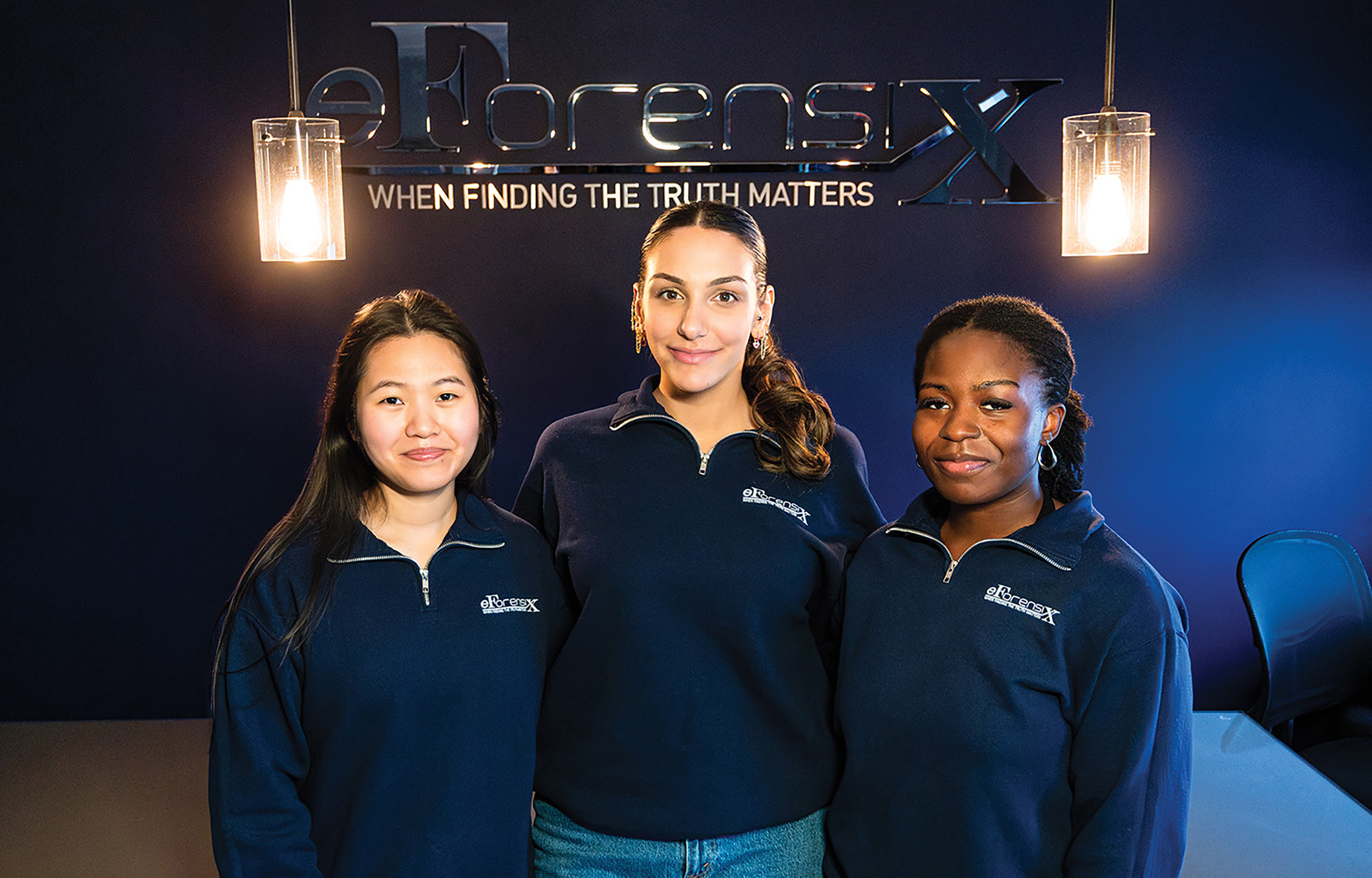
But last year, when forensics student Mia LoRé ’26, ’27 helped unravel the case of a Pennsylvania man wrongly accused of a crime, she experienced just that. Ray Wooden spent more than a year in jail before LoRé and two NJIT alumnae, Carmen Cheung ’24 and Gillian Kongnyuy ’23, helped free him by analyzing cellphone data. All three work in digital forensics at the New Jersey firm eForensix.
“This field is the intersection of justice and objective fact,” said LoRé, vice president of the Forensic Science Student Association (FSSA). LoRé, who works part-time at eForensix, is also pursuing a master’s in Cybersecurity and Privacy at NJIT, and applying to work for the federal government.
Wooden’s case was the second time members of NJIT’s forensic science program helped exonerate wrongly imprisoned people. In 2023, an NJIT team’s crime scene reconstruction of a 1994 Queens, N.Y., shooting cleared two men who had spent a combined 37 years behind bars after being wrongly convicted of murder.
LoRé, Cheung and Kongnyuy’s expertise was honed at NJIT’s groundbreaking forensics program. Not only is it the only accredited program in New Jersey, its growth is affecting the demographics of the university by attracting more women to NJIT. “It’s a game changer for the entire university,” said Kevin Parmelee, a retired detective from the Somerset County (N.J.) Prosecutor’s Office Forensic Laboratory and a senior university lecturer. “The program filled a huge void that was in New Jersey.” Although it only began in 2019, the forensics program is already bigger than most other majors in the Jordan Hu College of Science and Liberal Arts, second only to biology. It boasts the highest percentage of female students (77%) of any degree program at the college. “Nationally, the field is split 70-to-30 women to men,” said Parmelee. The FSSA, meanwhile, is one of the largest clubs on campus, with more than 300 members.
The program filled a huge void that was in New Jersey.”
- Kevin Parmelee
There are plenty of reasons forensics appeals to women; Parmelee noted that it’s an “altruistic field,” and one that students can pursue even if they don’t want to be police officers. “People feel like they are making a difference,” he said. “Plus, people like a good whodunit; by their nature they like to solve puzzles. Forensics utilizes STEM and technology, there are a lot of labs and it’s very hands-on, so students get to learn by doing. They have done the work — and it helps them land jobs.”
According to the U.S. Bureau of Labor Statistics, employment of forensic science technicians is projected to grow 13% from 2024–2034, much faster than the average for all occupations, added David Fisher, director of the program. At the moment, Fisher said, “Digital forensics is the fastest growing field — especially now with all the deepfakes and AI-generated videos.”
 Critical Thinking
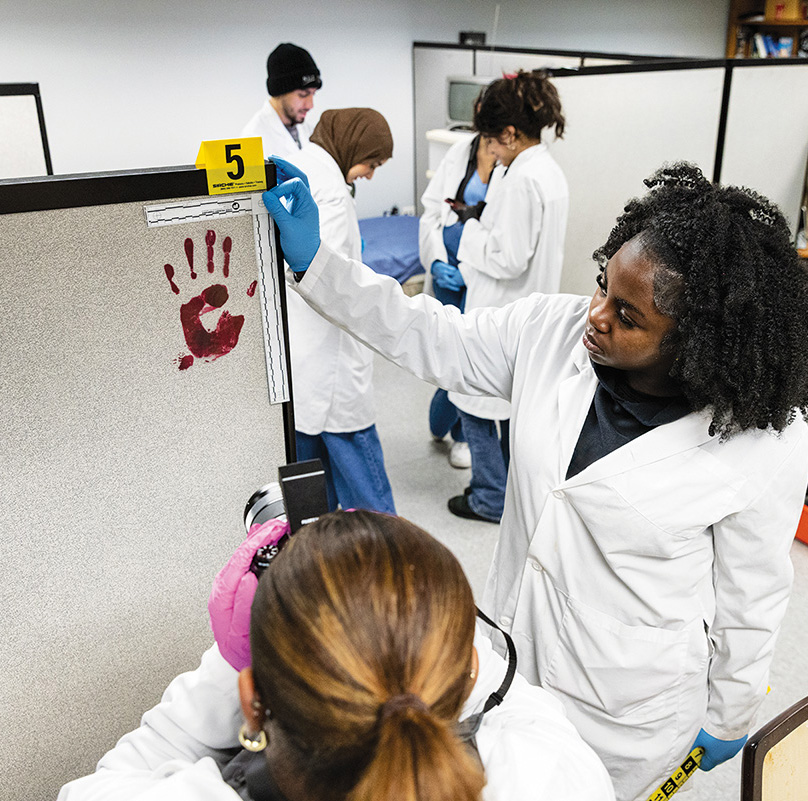
Inside a classroom designed to look like an apartment, teams of students in an Introduction to Crime Scene Investigation class are searching for clues and dusting for fingerprints. Parmelee, who is playing the role of a first responder, looks on while students move through different “rooms” set up with cubicle dividers. There is a living room and a bedroom, for example, where a mock knife can be spotted, or a bloody footprint photographed.
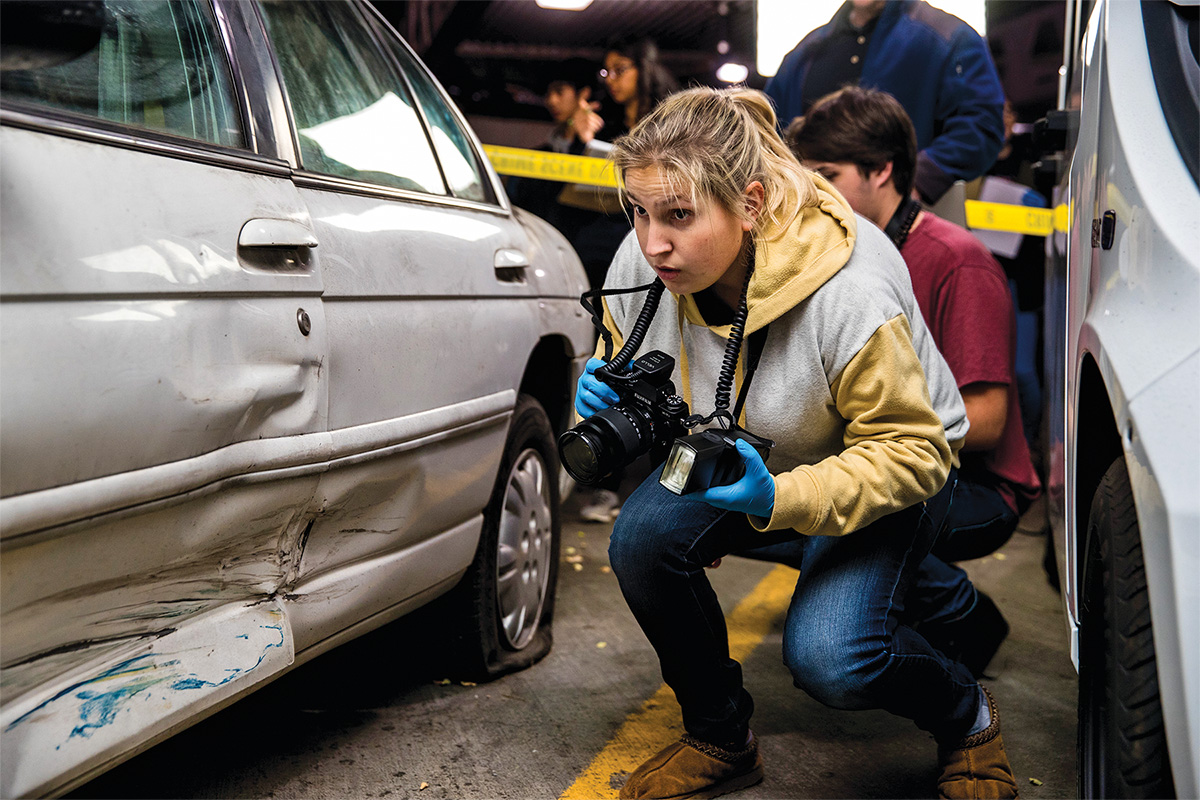
“The students have to practice critical thinking skills,” said Parmelee. “The scenarios get more complicated as time goes on. They take photographs of the crime scene that are time-stamped and they also collect evidence.” His class, like most, has a waitlist for enrollment.
The program continues to expand, and for the past two years undergraduate forensics students at NJIT have won a highly competitive, national scholarship from the American Society of Crime Laboratory Directors. Run through the Department of Chemistry and Environmental Science, the program has three concentrations: Forensic Biology, Forensic Chemistry and Digital Forensics. A new Crime Scene Investigation (CSI) track will soon be added. It also allows for interdisciplinary projects, for example, a seed grant allowed the program to work with Ying Wu College of Computing Informatics Professor Margarita Vinnokov and Hillier College of Architecture and Design Manager of Emerging Technologies Mike Kehoe, which created a virtual reality (VR) application with an immersive crime scene lab.
Cheung, a digital forensic technician at eForensix since 2024, finds the career rewarding. Cases like Wooden’s, she said, “really put into perspective what we do here and how important it is.” At NJIT, where she majored in forensics, she said, “The professors were really hands-on. They cared how you did in your classes and how you would succeed in your life.” As a child she’d taken an early interest in dentistry, but by the end of high school she was looking at forensics. At NJIT, she joined FSSA and the cybersecurity club.
Kongnyuy, who moved to New Jersey from Cameroon when she was 9, said she first got interested in forensics in high school, where it was “the only cool” elective she could take. As a Highlander, she appreciated the collaboration between faculty and students, and was drawn to digital forensics. People often think experts like her are “magicians” and can hack into anything, she said, while at the same time the average person doesn’t understand how much information their phones and computers store — even after they’ve deleted something.
Kongnyuy said ultimately she would like to work in government. “Forensics is a great way to help people,” she said.
Zoe Welch ’24 is the program’s first graduate to join the exclusive ranks of New Jersey’s State Police (NJSP). Just before graduating from NJIT with a double major in forensic science and biochemistry, Welch entered the NJSP’s yearlong application process.
“I liked the field work more than the lab side of forensics,” said Welch. “The CSI class and hands-on experiences I got at NJIT, like visiting the Newark Ballistics Laboratory and New York City Office of Chief Medical Examiner, inspired me.” She also helped Parmelee launch NJIT’s Shoeprint Image Capture and Retrieval (SICAR) database — one of only two N.J. forensic footwear databases.
 Prime Time Detectives
Many students cite popular television shows as part of what initially drew them to the field. Welch, for example, said her path began with a love of science and math in grade school, along with watching TV shows,
such as The Flash, whose main character, Barry Allen, works as a forensic scientist.
Pranav Prabhu ’26, president of the FSSA, said he is a big fan of the show Dexter, which often features blood spatter analysis. “It gave me the perspective that it would be an intriguing field to join,” he said. An Albert Dorman Honors College student majoring in forensic science with a concentration in biology, he said, “It seemed like an exciting field, and it is an applied science, so you are not just learning theory.” Prabhu is a volunteer EMT in Edison, N.J. and is applying to medical school. “I have had a lot of mentors at NJIT,” he said. “The professors are all phenomenal and I don’t know that I would have gotten that at a larger university.”
Jessica Verma, a junior from Elizabeth, N.J. majoring in forensic science in the biology track, said classes in high school helped bring her into the field. “I was also always interested in mysteries, and I learned that NJIT had a major. Also, TV shows got me interested. I watched Criminal Minds all through COVID and I said, ‘I want to do that,’” she explained.
Cheung said her favorite show is Bones, about a forensic anthropologist. “I’m re-watching it right now,” she said, laughing.
Research is another aspect of forensics at NJIT. Sara C. Zapico, an assistant professor of chemistry and environmental science, for example, is also a research collaborator at the Smithsonian Institution. Her laboratory, the Interdisciplinary Forensics and Biomedical Sciences Lab, explores new ways to extract identifying information from human DNA that can assist in everything from CSI cases to identifying victims of mass disasters.
Fulbright scholar and Ph.D. candidate Maria Castagnola, who studies with Zapico, is finding new ways to extract DNA from partial bones or teeth, while tracking subtle chemical changes in DNA from these remains — known as methylation patterns — that change predictably with age.
Her work could help pinpoint a person’s age even decades after death.
The CSI class and hands-on experiences I got at NJIT, like visiting the Newark Ballistics Laboratory and New York City Office of Chief Medical Examiner, inspired me.”
- Zoe Welch ’24
“In forensic anthropology, age estimation in adult individual remains is challenging, often with errors of plus or minus 10 years,” Castagnola said. “Our work focuses on specific DNA sites that relate to chronological age, particularly in teeth, which resist degradation longer than other tissues.” Her research has already drawn attention at major forensic science conferences — including the American Academy of Forensic Sciences conference, the nation’s largest gathering in the field. Castagnola said her work could soon be adopted by crime scene investigators and forensic anthropologists to support humanitarian efforts worldwide.
