Spring 2026
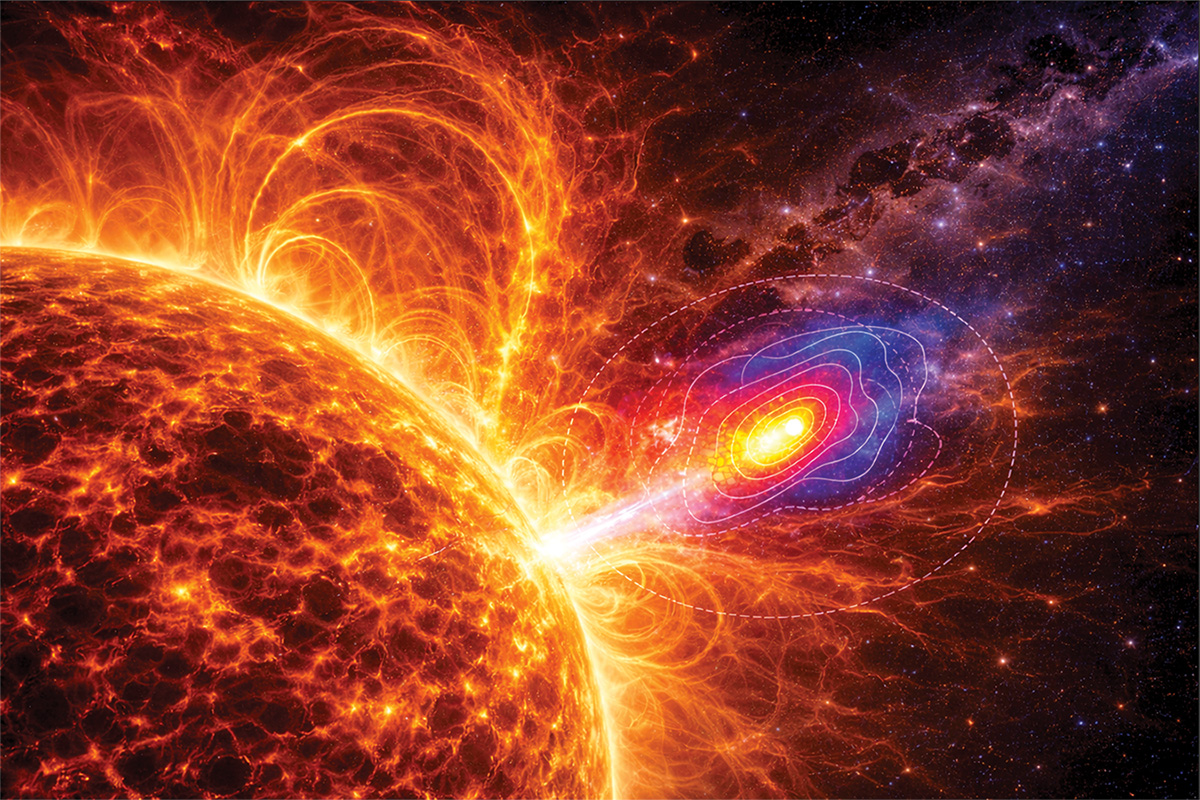
Solar physicists at NJIT’s Center for Solar-Terrestrial Research (NJIT-CSTR) have revealed a key source of intense gamma rays unleashed when Earth’s nearest star produces its most violent eruptions, according to findings in Nature Astronomy.
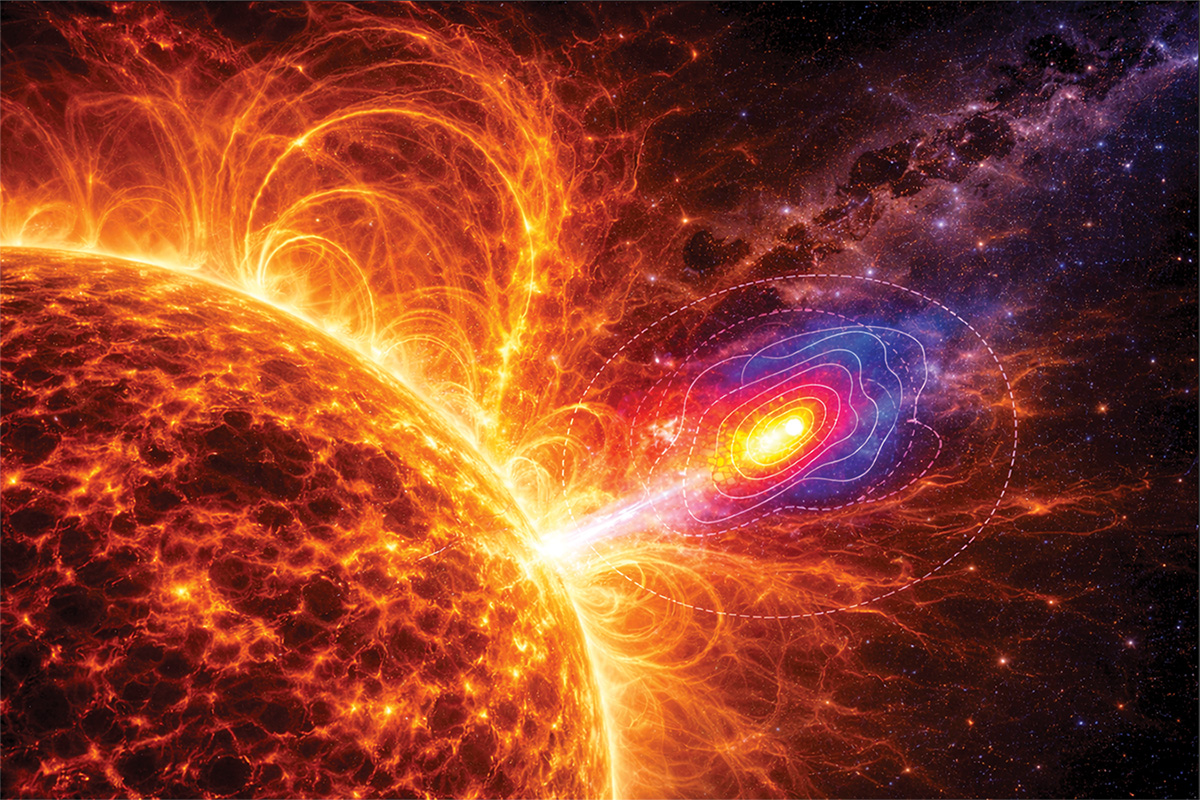
The team uncovered a class of high-energy particles in the sun’s upper atmosphere responsible for generating long-puzzling radiation signals seen during major flares for decades. Their discovery fills key gaps in solar physics and could improve space weather forecasting.
“By combining gamma-ray and microwave observations, we finally solved this puzzle,” said Gregory Fleishman, NJIT-CSTR research professor and lead author of the NASA- and NSF-funded study.
The team traced gamma-ray signals to a region in the solar corona during a powerful X8.2-class flare on September 10, 2017. There, trillions of particles were detected at energies of several million electron volts — hundreds to thousands of times greater than typical flare particles.
These near-light-speed particles generate gamma rays through “bremsstrahlung,” emitting high-energy light as they collide with solar plasma.
Combining data from NASA’s Fermi Gamma-ray Space Telescope and NJIT’s Expanded Owens Valley Solar Array (EOVSA), researchers pinpointed this previously unknown particle population in a region of the solar atmosphere called ROI3, where microwave and gamma-ray signals converged. The team now hopes to answer fundamental questions about these extreme particles — including their potential impact on space weather interactions with Earth’s atmosphere.
