Fall 2026
By Tracey L. Regan
“We found them in every one of our 52 groundwater wells, which are scattered over four townships. We couldn’t find water to buy that didn’t have PFAS in it,” Calbi ’94, ’00 recalled.
Known as “forever chemicals,” PFAS (per- and polyfluoroalkyl chemicals) were used for decades in protective coatings to withstand heat, fire, oil and water. The tight carbon-fluorine bonds that make them durable ensured their persistence in the environment, where they have accumulated in rivers, aquifers, household taps and even human blood. They have suspected links to diseases such as cancer, immunological problems and developmental delays in children.
“All across New Jersey and the U.S., water utilities are discovering PFAS in their drinking water. They are the single most impactful contaminants of our era. They’re in groundwater, sewage and the products we use. Everyone comes into contact with them. PFAS is in a lot of stuff.”
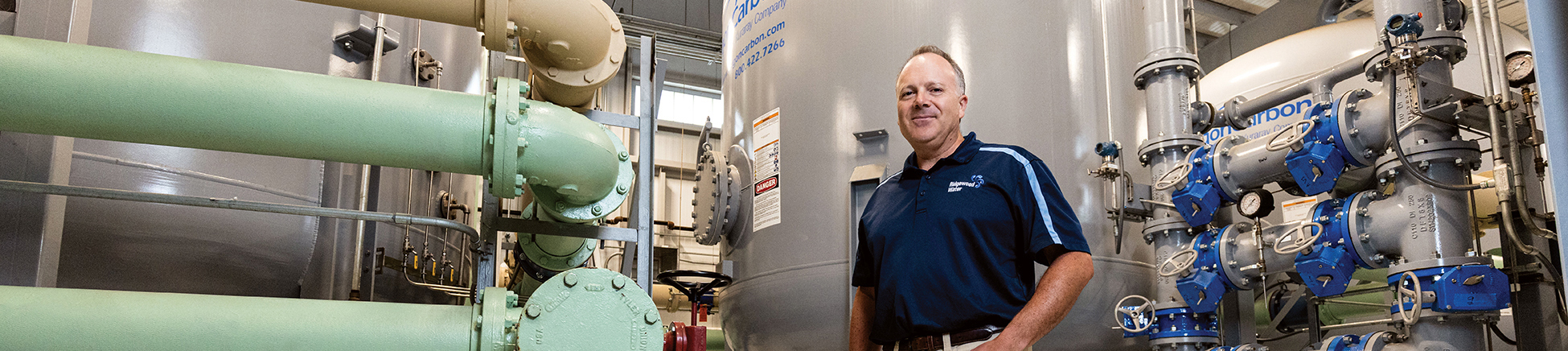
Calbi and his team set out immediately to reimagine and build an entirely new treatment system to protect the municipal water supply for the utility’s 61,000 consumers. Armed with a master plan completed in advance of the coming regulations, they designed and began installing a network of 12 plants containing enormous steel treatment tanks — some as tall as 24 feet — that are connected by nearly 13 miles of water mains. The final plant will come online early next year.
Their swift response, effective public outreach and ongoing efforts to optimize the system through research collaborations have made Ridgewood Water a model for utilities that are still coming into compliance. Based on his experience, Calbi plays an influential role in an NJIT-led consortium to coordinate and improve PFAS management in the state.
“PFAS treatment at the time was on a small scale and utilities didn’t know how to scale it up,” noted Calbi. In 2020, for example, Ridgewood’s existing treatment plants could not accommodate the massive new filters. “So we brought together engineers, academics, water companies, equipment makers and policy people to figure out how do it smartly and efficiently.”
All across New Jersey and the U.S., water utilities are discovering PFAS in their drinking water. They are the single most impactful contaminants of our era.”
He not only had to build a new system, he had to sell it to elected officials and the public. The $150 million price tag was the utility’s largest expense ever. In the absence of upfront payouts from polluters, his team scrambled to find funding from additional sources, such as the New Jersey Infrastructure Bank. The utility has since taken legal action against companies whose facilities leached PFAS into the region’s groundwater, although Calbi could not comment further.
“We needed to let residents know that we were addressing the problem ahead of others; that we had studied it, made a plan and were building the facilities to manage it,” he recounted. “We had community meetings in all four towns, updated people on a weekly basis and used social media. We saturated the public with as much information as we could.”
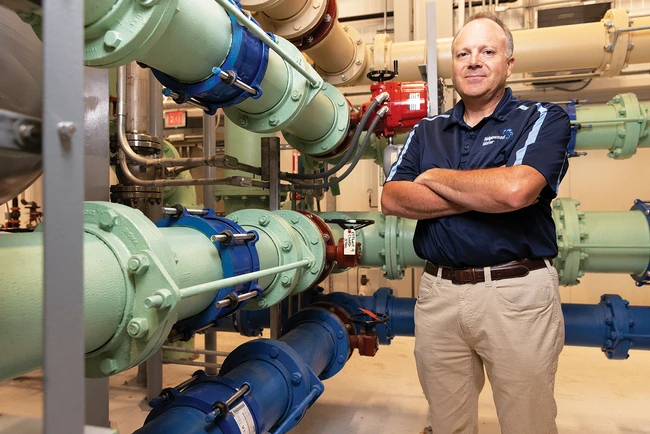
Ridgewood Water is now looking for new ways to optimize the system, which is expensive to run. The utility’s 40 treatment vessels use more than 900,000 pounds of treatment material, granulated active carbon flakes, to absorb the chemicals as they collectively process up to 18 million gallons of water a day.
“We’re continuing to learn and find better ways to do this,” says Calbi, who is involved in efforts with NJIT researchers to develop new technology to improve treatment and reduce its cost.
“For example, we want to come up with faster detection and extend the life of our filters. NJIT researchers at the company PFASolve, which I advise, are coming up with new methods that would give us instant results, because we spend a lot of time and money waiting (for results from labs). We want to know when the carbon we’re using is breaking down and when we have to change it out.”
Facilities now pay between $300 and $400 per sample analysis, while waiting up to three weeks for results. “You may be testing 100 wells on a regular basis,” said Michael Ehrlich, a professor of finance and one of PFASolve’s co-founders.
PFASolve co-founder Arjun Venkatesan, an associate professor of civil and environmental engineering, recently tested a different type of technology in Ridgewood’s wells: a prototype that pre-treats contaminated drinking water with a chemical compound that modifies the structure of PFAS, enabling higher adsorption onto carbon water filters and thus extending their life.
Atam Dhawan, senior vice provost for research and NJIT’s chief strategic innovation officer, was so impressed with Ridgewood Water’s response to the problem that he recruited Calbi to help him build the New Jersey PFAS Partnership Innovation Consortium. Shortly after attending a PFAS event at NJIT, Calbi got a call from Dhawan with a direct request: “I need your help.” Because he knows so many people throughout the sector, Calbi is a brilliant networker who in turn helps open doors and recruit leaders, experts and practitioners to the growing organization.
The consortium facilitates partnerships by sharing utility-specific contamination data and information about technologies in development. It also supports technology testing and validation as a pathway to commercialization, promotes advocacy for clean-up initiatives and provides workforce training for on-site remediators. Founding members of the consortium include engineering companies such as Langan, AECOM, Battelle, ResinTech and T&M Associates; water company Veolia; utilities such as Ridgewood Water and Jersey Water Works; the New Jersey Commission of Science, Innovation and Technology; the state Department of Environmental Protection; universities such as Princeton, Rutgers, Stevens and NJIT; and start-up companies, among others.
“Rich not only has incredible engineering expertise, he has partnerships with technology innovators in academia and industry, policy makers and government officials towards addressing PFAS contamination,” Dhawan said. “He networked throughout the state to develop and implement a massive infrastructure project that is a wonderful blueprint for successful public utility remediation.”
Calbi said he was eager to help.
“As an NJIT grad, I always wanted at some point to give something back,” he said. “And how better than to leverage my experience with PFAS in Ridgewood by assisting with research. There is also an education piece. The professors want their students to get ahead of the curve as they train the next generation of engineers to lead this industry.”
Some of the bigger utilities, which are now having to come into compliance as the U.S. Environmental Protection Agency tightens PFAS pollution standards, are learning from smaller utilities, such as Ridgewood.
“I participate in a group with the Passaic Valley Water Commission, Veolia and New Jersey American Water to determine what’s working and what isn’t,” Calbi said. “We spent $150 million and they’re going to have to spend many times that.”
While New Jersey is proceeding quickly to manage the problem, much of the country lags far behind.
“Nationally, it’s moving slowly,” Calbi noted. “A lot of water systems are doing nothing and will be playing catch-up as their states develop regulations.
While there is much work ahead to optimize and maintain Ridgewood’s system, Calbi savors some rewards from early compliance.
“The new filters have other benefits: they remove organic pollutants and improve taste, color and odors,” he noted. “Now it’s actually a plus to say that you have Ridgewood water.”
