Fall 2026
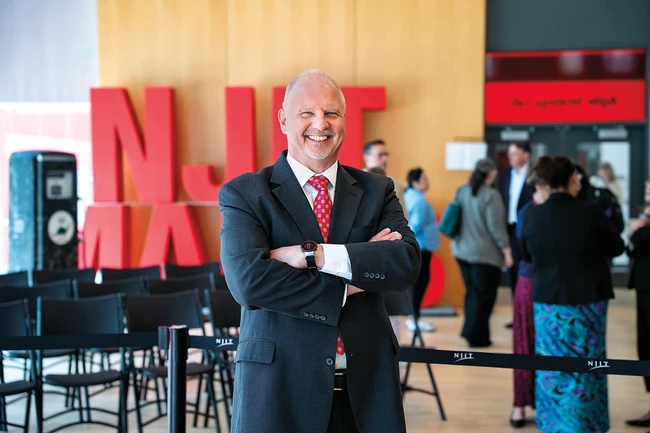
John A. Pelesko ’95 was appointed interim president of NJIT this past summer, following the retirement of former President Teik C. Lim.
A New Jersey native, Pelesko earned his doctorate in mathematical sciences from NJIT and returned to the university in 2023 as provost and executive vice president for academic affairs. In that role, he oversaw the university’s colleges and schools, research enterprise, enrollment management, undergraduate and graduate studies, global initiatives and career development services.
During his tenure as provost and executive vice president, Pelesko helped shape NJIT’s strategic plan, strengthened the university’s research activity and led AI@NJIT, an institution-wide initiative preparing students and academic programs for an economy increasingly influenced by artificial intelligence.
“Dr. Pelesko brings significant experience, vast institutional knowledge and a strong commitment to NJIT’s mission and values to the interim presidency,” said NJIT Board of Trustees Chair Robert C. Cohen ’83, ’84, ’87. “Throughout his time at NJIT, John has demonstrated thoughtful and steady leadership, sound judgment and dedication that will help ensure continuity and stability during this transition period.”
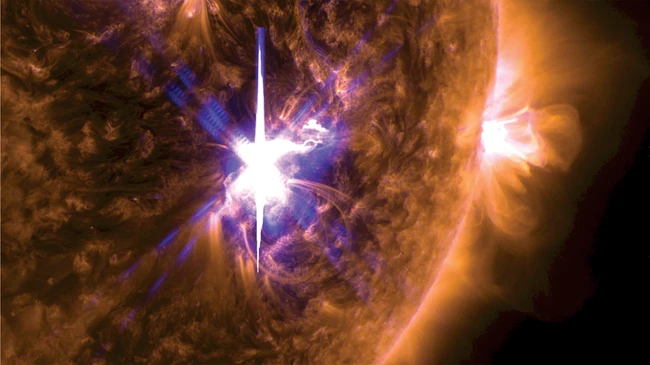
In 1859, astronomer Richard Carrington witnessed a sudden flash from the sun. The flare was followed by an extreme geomagnetic storm that produced auroras at unusually low latitudes and disrupted telegraph systems around the world.
The event later became known as the Carrington Event — the first recorded observation of a white-light solar flare.
More than 160 years later, scientists are still trying to understand exactly how these eruptions on Earth’s nearest star transport energy into the lower layers of the sun’s atmosphere, producing visible white-light emission and, in some events, seismic disturbances known as sunquakes that ripple across the solar surface.
Samuel Granovsky, a doctoral researcher at NJIT’s Center for Computational Heliophysics, is now exploring these events with a Future Investigators in NASA Earth and Space Science and Technology (FINESST) fellowship, which provides $150,000 over three years.
“White-light flares vary in size and frequency,” Granovsky said. “While Carrington-class events are roughly once-in-a-century, strong X-class flares can occur multiple times a month during the peak of the sun’s 11-year cycle, which may disrupt satellites and ground electrical equipment. It’s important to better understand the underlying physics behind these events.”
Like other solar flares, white-light flares are often triggered when twisted magnetic fields in the sun’s corona suddenly snap and reconfigure, Granovsky said.
NJIT placed No. 10 among public colleges in a national return-on-investment analysis published by Stacker. The list highlights four-year public institutions that predominantly grant bachelor’s degrees and ranks them by 40-year return on investment.
The Stacker placement adds to a series of external rankings recognizing NJIT for value and graduate outcomes. The Wall Street Journal ranks NJIT No. 1 among New Jersey public universities for both alumni salaries and value, placing the university No. 25 nationally for salaries and No. 42 overall for value. The Princeton Review also ranks NJIT No. 27 nationally among its Best Value Public Colleges.
NJIT also earned the highest rating awarded to a public university in New Jersey in Money’s 2026 Best Colleges guide. NJIT earned 4.5 out of 5 stars, the highest rating awarded to a New Jersey public university and trailing only five-star Princeton University among institutions statewide.
The recognition reflects NJIT’s combination of an accessible public-university education, strong academic programs and career outcomes. Money describes NJIT as a “launchpad for future engineers and architects” and highlights its technical education, small classes, hands-on career preparation and programs in engineering, computing, business and architecture. The publication reports median alumni earnings of nearly $92,000 four years after students leave the university.

One of the few U.S. colleges devoted entirely to computing, and the largest comprehensive computing college in the New Jersey/New York metropolitan area, the Ying Wu College of Computing (YWCC) marks 25 years this fall. In addition to new courses on AI and participation in New Jersey’s statewide AI initiatives through the NJ AI Hub, YWCC has programs in data science, cybersecurity, informatics and software engineering.
NJIT is also part of the hub’s Faculty Futures AI Studio, a cross-institutional initiative designed to empower higher education leaders throughout New Jersey to aid in transforming the future of AI-infused teaching, learning and academic integrity. YWCC Dean Jaime Payton, along with Oya Tukel, dean of the Martin Tuchman School of Management, were part of the inaugural cohort of faculty fellows with the Faculty Futures AI Studio, creating modules for AI learning that could be adapted by universities.
Payton’s role centered on creating curriculum resources to build capacity to teach technical AI courses throughout higher education in alignment with national standards. “We have experienced enormous growth in just over two years in AI research and education, with courses, programs and faculty that are well-positioned to equip all NJIT students — regardless of major — with the knowledge and skills that are critical to navigating the rapid advances in AI on a global level,” Payton said.

Content creators and ordinary Google users alike are harmed by artificial intelligence summaries of search queries, because the summaries are often inconsistent, presenting disreputable results and withholding information from better sources that restrict Gemini training bots, NJIT researchers found.
Power users have long suspected these concerns, but now it’s documented based on examination of more than 14,000 search results, explained Riley Grossman, a fourth-year doctoral student in business data science. His paper How Generative AI Disrupts Search: An Empirical Study of Google Search, Gemini, and AI Overviews was presented in Australia this summer at the ACM Conference on Research and Development in Information Retrieval.
The results come from research focused on understanding how the digital publishing industry responds to potential threats, Grossman said. His team, led by professors Yi Chen and Cristian Borcea in NJIT’s management school and computing college, initially looked at online privacy regulations. They added an emphasis on digital search impacts after seeing publishing companies cite that newsroom layoffs were due to generative artificial intelligence taking away search clicks, much as online news itself decimated print journalism.
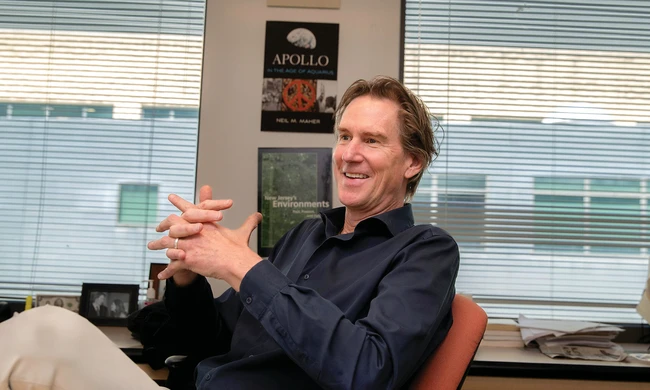
NJIT historian and master teacher Neil Maher was named a 2026 Andrew Carnegie Fellow, becoming the first faculty member in university history to receive the national honor.
Selected from more than 380 nominees nationwide, Maher is one of only 24 scholars chosen for the fellowship this year, which awards up to $200,000 to support original research in the humanities and social sciences.
The fellowship will support Maher’s ongoing research and forthcoming book project, tentatively titled Unequal Natures: Building Consensus Across a Segregated City.
The work explores the rise of Newark’s environmental justice movement in the decades following World War II, tracing how residents confronted pollution, unsafe housing and public health crises — and, over time, built coalitions across deep social divides.
“Everyone knows about the unrest in Newark during the summer of 1967,” Maher said. “But what’s often overlooked is how environmental problems were part of that story, and how people eventually came together across lines of difference to address them.”
Maher’s project builds on years of research. Alongside archival study, he has collected oral histories from generations of Newark residents and activists and worked extensively in local collections, including those at the Newark Public Library.
Maher’s scholarship and environmental focus extend beyond the classroom through ongoing collaboration with local community partners, including the Newark Water Coalition (NWC).
