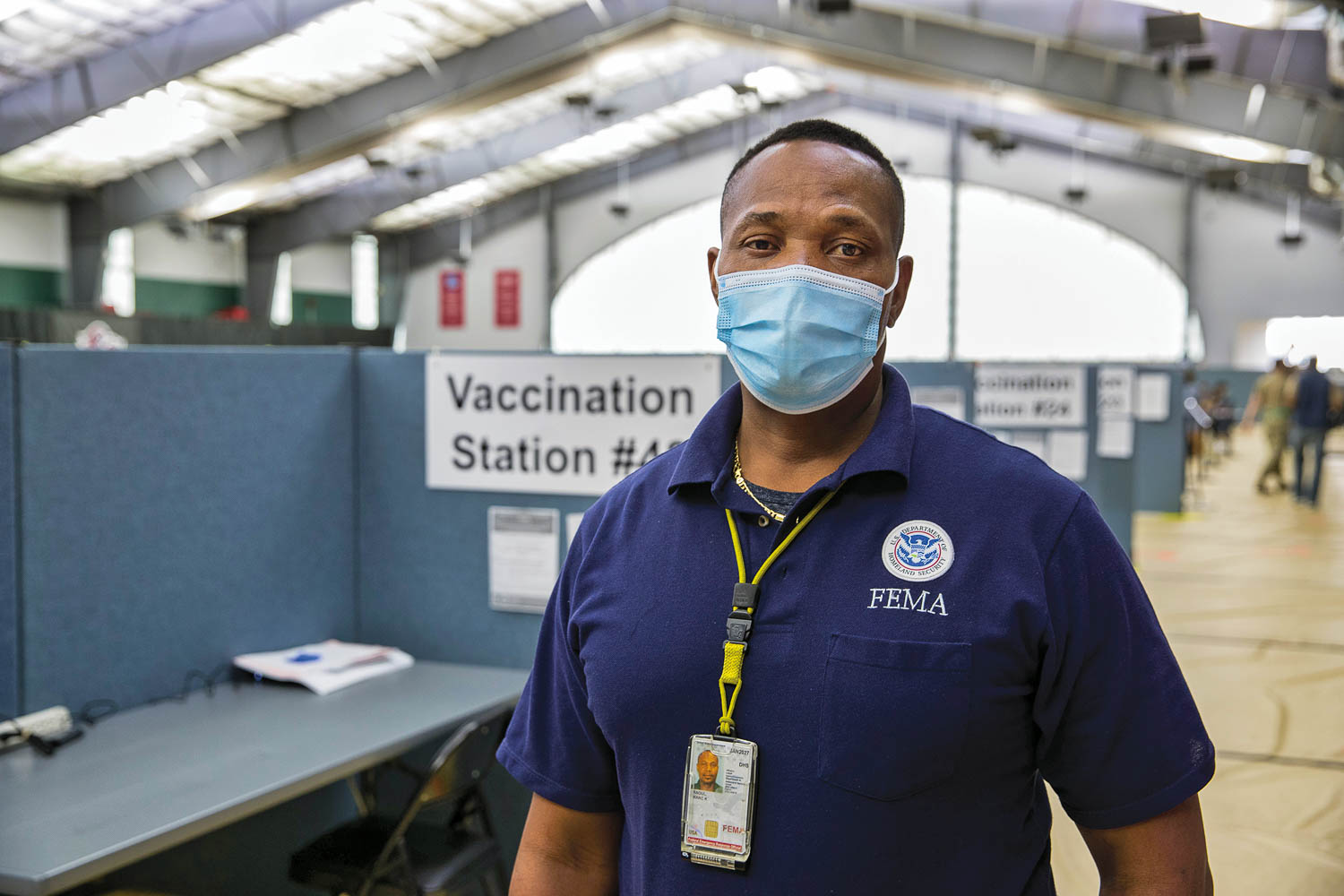
FEMA’s Marc K. Raoul ’10
Helps Disaster-Struck
Communities Recover
Marc K. Raoul ’10, an emergency management specialist for FEMA, has traveled across the U.S. and its territories to help communities recover and rebuild following hurricanes, floods and pandemics. A veteran of Hurricanes Sandy (2012), Irma (2017) and Maria (2017), he has been a damage assessor, a disaster recovery planner and a proposal reviewer for towns and cities in New Jersey, Florida, South Carolina, Georgia, New York, Missouri, California, the U.S. Virgin Islands and Puerto Rico. He also helped operate FEMA’s NJIT-based COVID-19 vaccination center in 2021.
Q: What drew you to engineering?
A: Growing up in Haiti, I was good in math and very creative in science. I aspired to be an engineer in high school, as there was such a need for civil engineers in Haiti to build residential housing, roads and water infrastructure. Later, as a student in the U.S., I was most interested in urban planning and civil, environmental and water resources engineering, as well as in principles of management, scheduling and estimating. When I saw a FEMA advertisement for local hires to help with disaster management in the wake of Hurricane Irene, I knew that, with my skill set, I could contribute.
Q: What is your role in disaster response?
A: I work on recovery assistance for states, local municipalities and certain private nonprofits that provide critical services to the communities, such as hospitals and nursing homes, but not on behalf of individual property owners. I assess the damage to roadways, bridges, public buildings and parks. I write recovery proposals for federal grants that include damage descriptions and dimensions, and, in some cases, the scope of work and cost estimates. I also compile applicants’ estimates for the work they’re contracting and make sure the proposals are effective, the costs are reasonable and that they follow federal policies
and procedures.
Q: How do you interact with communities?
A: I ensure that the survivors are back on their feet. I talk to community members about how to prepare for their recovery — to understand the scope of work that needs to get done. I explain the policies, laws and regulations of the public assistance program, and ensure that they follow environmental and historical preservation guidelines, as well as hazard mitigation planning to build back better to avoid similar damages in the future.
In the aftermath of Maria in the Virgin Islands, I was the person on the ground serving as the public assistance crew leader, training local hires to help their community, and conducting multiple meetings with the survivors to explain the role of the public assistance program. Local hires had a lot of skills, but hadn’t worked on public assistance. I also met with members of the U.S. Congress to explain what FEMA was doing to help the islands recover. The devastation there was huge. There were landslides, damaged roads, many roofs blown off and so much debris, including fallen trees blocking streets. The recovery was very costly, because it’s expensive to transport so many materials to islands.
Q: How does Sandy stand out among disasters?
A: It was an amazing moment for me, because it was a Category 5 disaster in New Jersey. I was assigned as a project specialist for Long Beach Island and the towns around it. It was terrible. LBI is located between Manahawkin Bay and the Atlantic Ocean, and when I got there, so much was still under water and so much property destroyed. The storm sewer system was damaged. The people there were survivors, but they were suffering. My job was to pinpoint what they needed to do to recover.
Q: Is your work with Sandy over?
A: I was detailed as a section chief to supervise recovery for all state agencies during Sandy and I’m still doing close-outs, including for the Passaic Valley Sewerage Commission, which operates the Newark Bay Treatment Plant and processes over 300 million gallons of wastewater per day. That was a very
big, complicated project and involved a number of agencies, such as the New Jersey Department of Environmental Protection.
Q: Are communities better prepared to cope with disasters than when you started 11 years ago?
A: I think they are better prepared to cope with disasters, due to the multiple events that have occurred over the past several years. Each disaster is different, and they therefore have learned to prepare for different situations. FEMA representatives always advise survivors to prepare for the future. For individuals, this means having emergency medical and repair kits, and for communities, it means rebuilding better by following up-to-date codes and standards and by mitigating hazards and improving infrastructure.
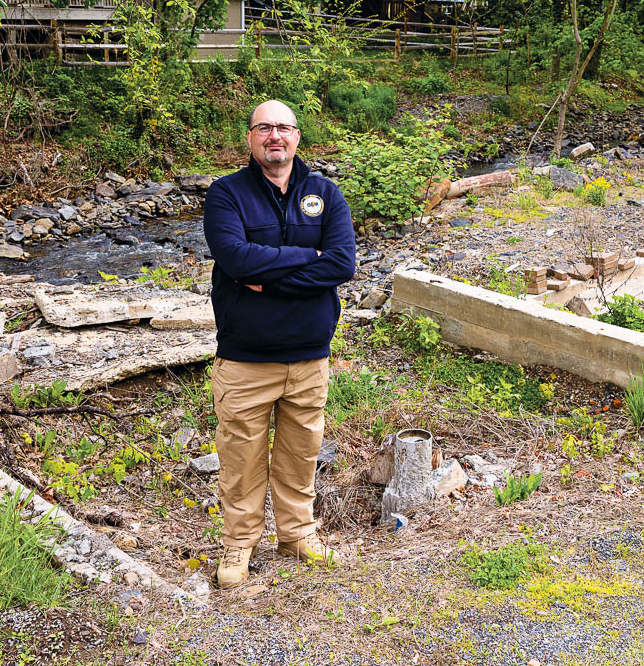
Christopher Testa, M.S. ’05
Manager of the Hazard Mitigation Unit and Supervising Administrative Analyst
New Jersey State Police
Office of Emergency Management
Over the course of several hours, Hurricane Ida pelted Lambertville, N.J. with nearly 10 inches of water. The city is flood-prone on four sides and lacks percolation; its channelized creeks surged over their banks, sweeping cars off the road and historic houses off their foundations. As he contemplates a future shaped by climate change, Chris Testa, M.S. ’05 doesn’t mince words: “There is going to be disruption; change is the one thing we can count on.” His job is to anticipate and manage its most calamitous impacts with cost-effective adaptations of the landscape and the built environment.
Q: What does your job entail?
A: The Office of Emergency Management administers FEMA hazard mitigation dollars; we’ve received about $1 billion on my 10-year watch. The thinking is that spending money before a disaster is a lot more cost-efficient than spending it after, cleaning up. We conduct buyouts through the N.J. Blue Acres program, housing elevations, mid-range flood and drainage projects, generator installations, infrastructure upgrades, risk assessments and hazard mitigation planning. We try to isolate the weakest links in the chain and make them more resilient.
Q: How does the OEM decide what fixes to make?
A: I see 100-year rain events every two or three years. Hurricane Ida was a 1,000-year event. I don’t think anyone knows where the finish line is, and it’s a challenge to design systems when you don’t know how bad things will be. We look for cost-effective opportunities with co-benefits. If we buy out a house in Lambertville, as we did after Ida, can we leave it in a state where it will absorb more flooding, regenerate it for habitat or create a pocket park? In terms of loss avoidance, supplying generators is the easiest decision. We can put a value on keeping police and fire stations operating. The next easiest is buyouts – that’s damages not incurred.
Q: Are there limits to what the OEM will fix?
A: There is a Goldilocks level that determines how far we go. If we’re replacing a bridge to a barrier island that will be under water in 50 years, do we want one that lasts 200 years? We need to right-size investments. In Manville, we’re going neighborhood by neighborhood with LIDAR technology to see how deep the water was in Ida and debating at what point it’s no longer appropriate to elevate a house.
Q: How do we address economic inequities in the system?
A: If we’re going to change the landscape — move people and buildings — it’s an opportunity to be more equitable in our approach, more cognizant of perverse incentives. Manville, for example, provides low- and moderate-housing opportunities for first-time homebuyers and immigrants. The tradeoff is it floods. Part of my job is communicating that risk so people can make an educated decision. And if we elevate a house with federal dollars, we will encumber it with a required insurance policy. Can the homeowner resell that house? In Bound Brook, which benefited from an Army Corps of Engineers flood control project, there is noticeable gentrification. In helping low-to-moderate income populations with a big structural fix, you may price them out of the market.
Q: What effect will climate change have on the tax base?
A: Buyouts affect a municipality’s tax base. Can Manville, for example, afford the loss of another 100 structures and provide the same level of municipal services? We look for offsets. One of them may be to build more housing in less risk-prone areas. In general, we’ll likely see more density in these areas going forward. Climate change will put stress on home rule – on the luxury of having small, independent municipalities. One question will be whether enough of your tax base is in non-hazard-prone areas. We can elevate houses at the shore, but who will elevate the roads at $1-2 million a mile? Will people a mile inland want to pay for that?
Q: How can we better protect human life?
A: Hunterdon County had six deaths during Ida, mostly from cars swept off roads by small waterways. We think some of those people recalibrated GPS maps when the major highways shut down. Using LIDAR, we can identify vulnerable areas and pair that with weather projection technology to proactively shut roads. In Elizabeth, flooding during IDA lapped the first-floor ceiling of a building with all ADA-compliant units on that floor – the least mobile population was in the most vulnerable part of the landscape. We’ve shot LIDAR across the 500-year flood plain of the entire state to see how high up first-floor elevations will have to go.
